From Battery Analytics to Agentic Optimisation: Key Takeaways from Battery Asset Management Summit UK & Ireland


As battery energy storage deployments continue to accelerate, the industry’s focus is shifting. The conversation is no longer centred solely on adding capacity. Increasingly, attention is turning to how battery assets are managed, optimised and protected throughout their operational lifetime.
At this year’s Battery Asset Management Summit UK & Ireland, one message came through consistently: battery asset management has become a core driver of profitability.
Asset Management Has Become a Business-Critical Function
The UK’s operational battery storage fleet has reached 8.7 GW and 14.1 GWh, and capacity grew 21% in the year to September 2026 (RenewableUK). The way these assets earn has also shifted. Wholesale trading and the Balancing Mechanism made up around 60% of GB battery revenues in the 12 months to April 2026, and both move with wind and solar output. GB battery revenues fell to £41k/MW/year in February 2026, when strong wind suppressed price spreads, then rose to £70k/MW/year in June, when negative prices and record spreads returned (Modo Energy).
With portfolios growing and revenues this volatile, operators are under increasing pressure to maximise performance and availability while maintaining long-term asset health.
Effective battery monitoring and asset management are now seen as essential capabilities rather than value-added extras.
Accurate visibility into battery health, availability and performance, helps operators minimise costs and maximise long-term returns.
Revenue Optimisation and Cybersecurity Dominate the Agenda
Across sessions and industry discussions, two concerns stood out above all others.
The first was revenue optimisation.
As storage assets become increasingly important participants in energy markets, operators are looking for ways to maximise yield, improve availability and make smarter operational decisions.
The second was cybersecurity.
Energy infrastructure is becoming more connected, more digital and more exposed. Discussions highlighted how cyber threats against energy systems are becoming more frequent and increasingly sophisticated. As AI becomes more accessible, attack volumes are rising and infrastructure operators are facing a 24/7 threat landscape.
For battery operators, cybersecurity is no longer simply an IT concern. It is becoming a core operational requirement.
The Next Evolution of Battery Intelligence
Most operators now run a battery analytics platform. Some build it in-house, many use the platform supplied by the battery system OEM or integrator, and others use an independent third-party provider. These platforms collect operational data in the cloud and use it to track state of health, availability and performance, flag faults and support warranty claims.
However, discussions at the summit suggested that the next wave of innovation is emerging both above and below the analytics layer.
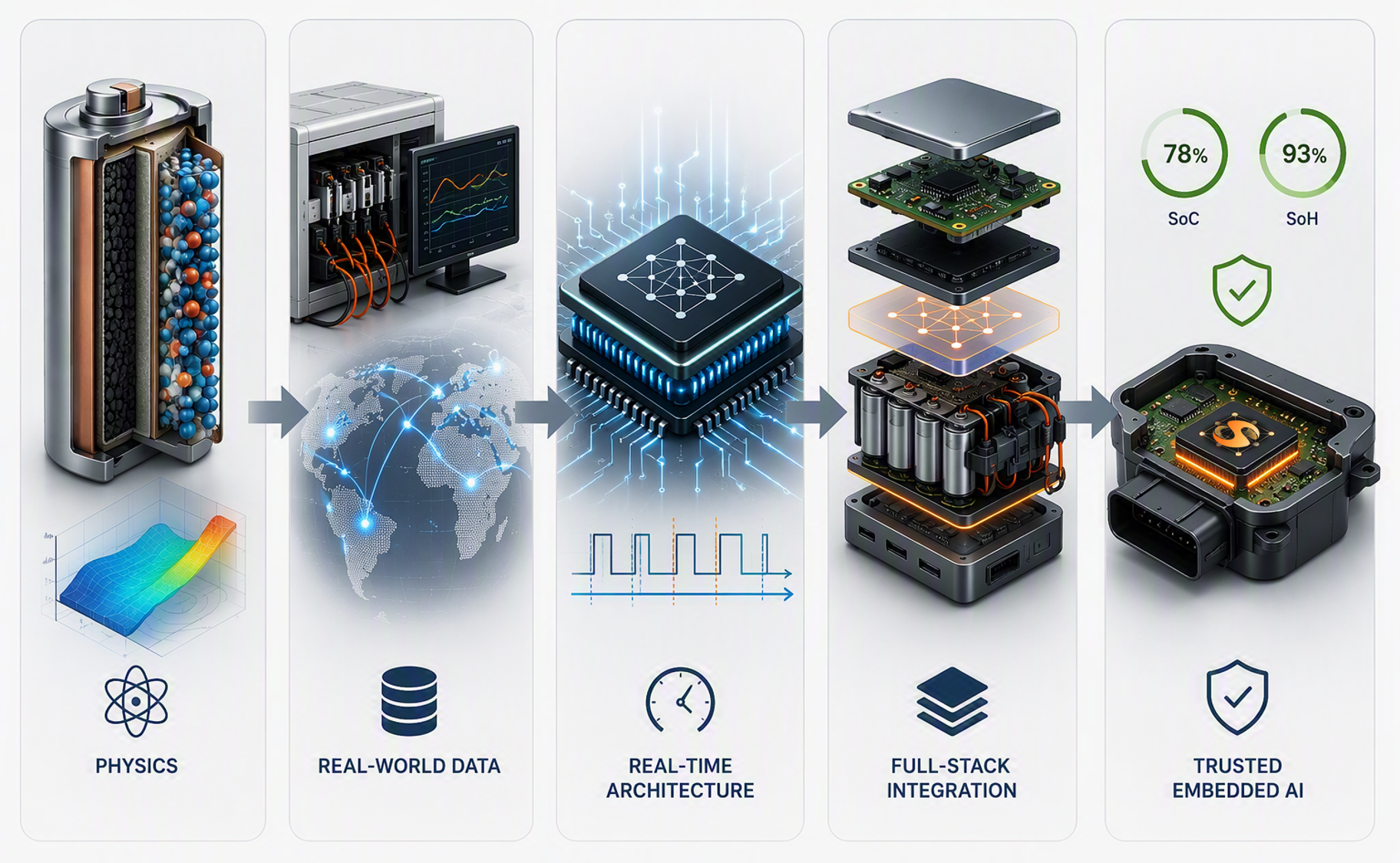
Below the analytics platform, there is growing recognition that optimisation depends entirely on data quality. This is driving interest in Edge AI, which runs on the asset and processes, validates and enriches battery data before it reaches the cloud.
Rather than simply transmitting raw information, intelligent edge devices can improve data quality in real time and provide faster, more reliable insights. Edge AI can also integrate directly into the battery control system, so its outputs act on the asset without a round trip to the cloud.
Above the analytics layer, attention is moving towards increasingly autonomous optimisation systems.
From Insight to Action
Many organisations are exploring how AI can move beyond reporting and analytics to support operational decision-making.
The emerging vision is an agentic optimisation layer capable of processing operational data, identifying root causes, evaluating options and providing recommendations automatically.
Importantly, the industry consensus remains that humans should stay in control of critical actions and high-consequence decisions. AI can accelerate analysis and decision support, but operational accountability remains with people. The quality of those recommendations depends on the data feeding the agentic layer. Inaccurate health or availability estimates produce wrong recommendations, whatever the capability of the AI.
Why Better Data Creates Value Beyond the Battery
One of the most interesting conversations at the event focused on market optimisation.
The discussion highlighted a powerful principle: optimisation at any level is only as effective as the quality of the underlying data.
Whether the objective is battery performance, portfolio management, energy trading or revenue forecasting, better decisions depend on better information.
This creates a clear connection between battery intelligence and commercial performance.
Looking Ahead
The future of battery asset management appears to be heading towards a new architecture:
Edge AI on the asset feeds accurate performance and health insights into increasingly autonomous optimisation systems. Together they form an edge-to-cloud loop that maximises value over the lifetime of the asset.
As battery portfolios continue to scale, success will increasingly depend on the ability to combine operational insight, intelligent software and human expertise into a unified optimisation strategy.
For companies operating across the battery value chain, the challenge is no longer simply collecting more data.
It is transforming that data into better decisions, faster actions and stronger commercial outcomes.