The Future of Physical AI Will Depend on Embedded AI

Physical AI is the next great wave: robots, humanoids, drones, autonomous vehicles and energy systems that act in the physical world rather than merely describe it. Whether these systems work safely and reliably will be decided not only by the large model on top, but also by the embedded intelligence running inside each component, sensing, estimating and acting in real time.
The term is everywhere now, and the excitement is justified. After a decade in which AI mostly read, wrote and recognised, the frontier is shifting to machines that act: robots that manipulate, drones that fly, vehicles that drive, and energy systems that operate autonomously. But the attention is landing in the wrong place. The future of Physical AI will require not only capable large models, but also intelligence that can operate reliably at the edge, on the hardware itself. That layer, running on the hardware itself, is the one the industry talks about least.
This is the final article in a series about embedded AI. We began by separating edge AI, which is only a deployment choice, from embedded AI, which is an engineering requirement. We looked at why intelligence in the physical world has to respect physics rather than just recognise patterns, why the data behind it takes years to build and cannot be copied, how the architecture is designed so the model can be trusted in real time, and what it actually takes to deploy that intelligence inside a real product, from the silicon up. I want to close by connecting all of it to where the industry is now heading, because embedded AI is where these threads converge.
Physical AI is built from the bottom up
A Physical AI system is a stack. At the top sits a coordinating layer, responsible for perception, planning and decision-making. Underneath sit the components that interact with the physical world: actuators, motors, power electronics, sensors and batteries. The coordinating layer gets the attention because it is visible and easy to demonstrate. The component layer determines whether any of it works safely and reliably.
The reason is simple. A humanoid robot is only as capable as its joint control, and only as safe as its power system is predictable. A drone is only as reliable as its flight controller and its battery when a gust hits. No coordinating model, however large, can compensate for a component whose local state estimate is incorrect, nor can it wait for a round trip to the cloud when a decision has to be made in milliseconds. And latency is only half of the argument: a safety case under ISO 26262 requires evidence of bounded behaviour and defined failure modes, which is achievable for a deterministic, physics-informed estimator and very difficult for a large model whose worst case cannot be enumerated.
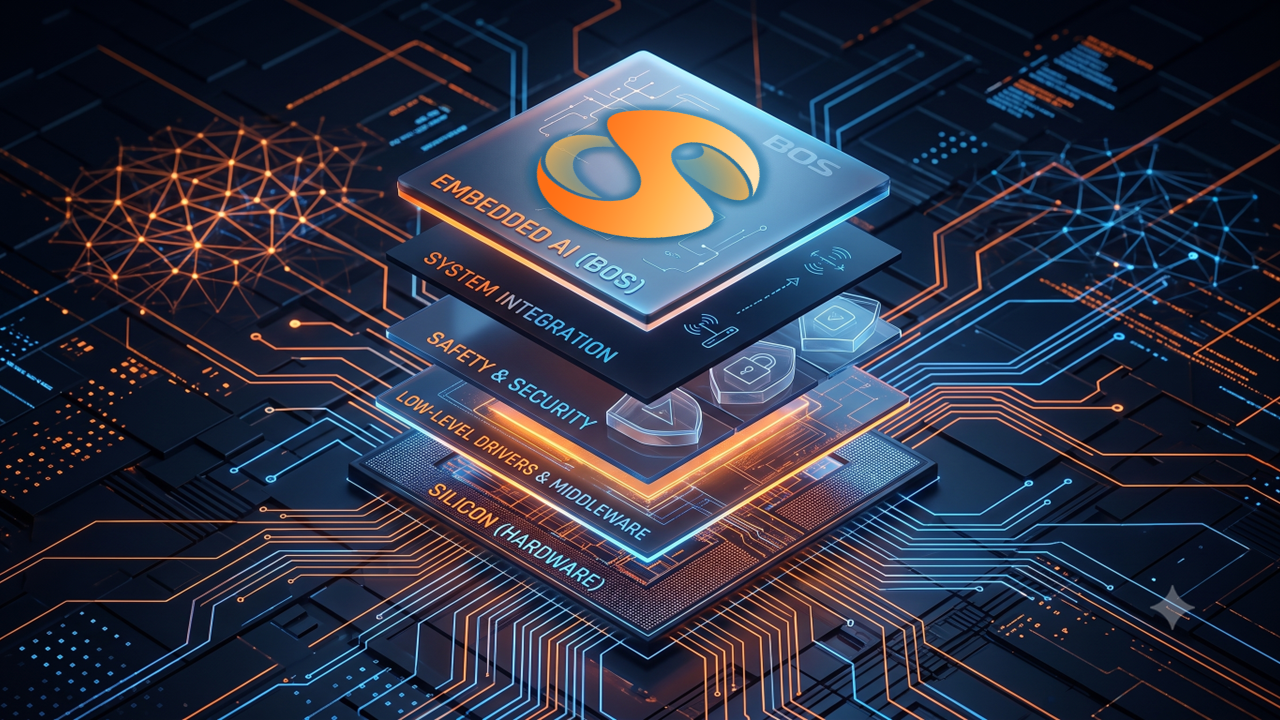
Safety and real-time control live at the component level, not at the top of the stack. So Physical AI succeeds or fails where intelligence meets hardware. That intelligence must be embedded, designed for constrained silicon, real-time operation and the physics of the system it controls. This is exactly the distinction we drew at the start of this series. It matters more here than anywhere.
It is fair to ask whether end-to-end learned control will eventually absorb this layer, and some of what is hand-engineered today will certainly be learned. But a learned policy can only act on what is measurable, and the states that matter most in a physical system, state of health among them, have to be inferred. And if the policy commanding the actuator cannot itself be verified, a bounded layer between that policy and the hardware becomes more necessary, not less.
Why the battery is the hardest case
Many Physical AI systems, from humanoids and drones to autonomous vehicles and grid-scale storage systems, share a common component: the battery. It is also the hardest embedded estimation problem in the stack, which is what makes it a good lens on the whole question.
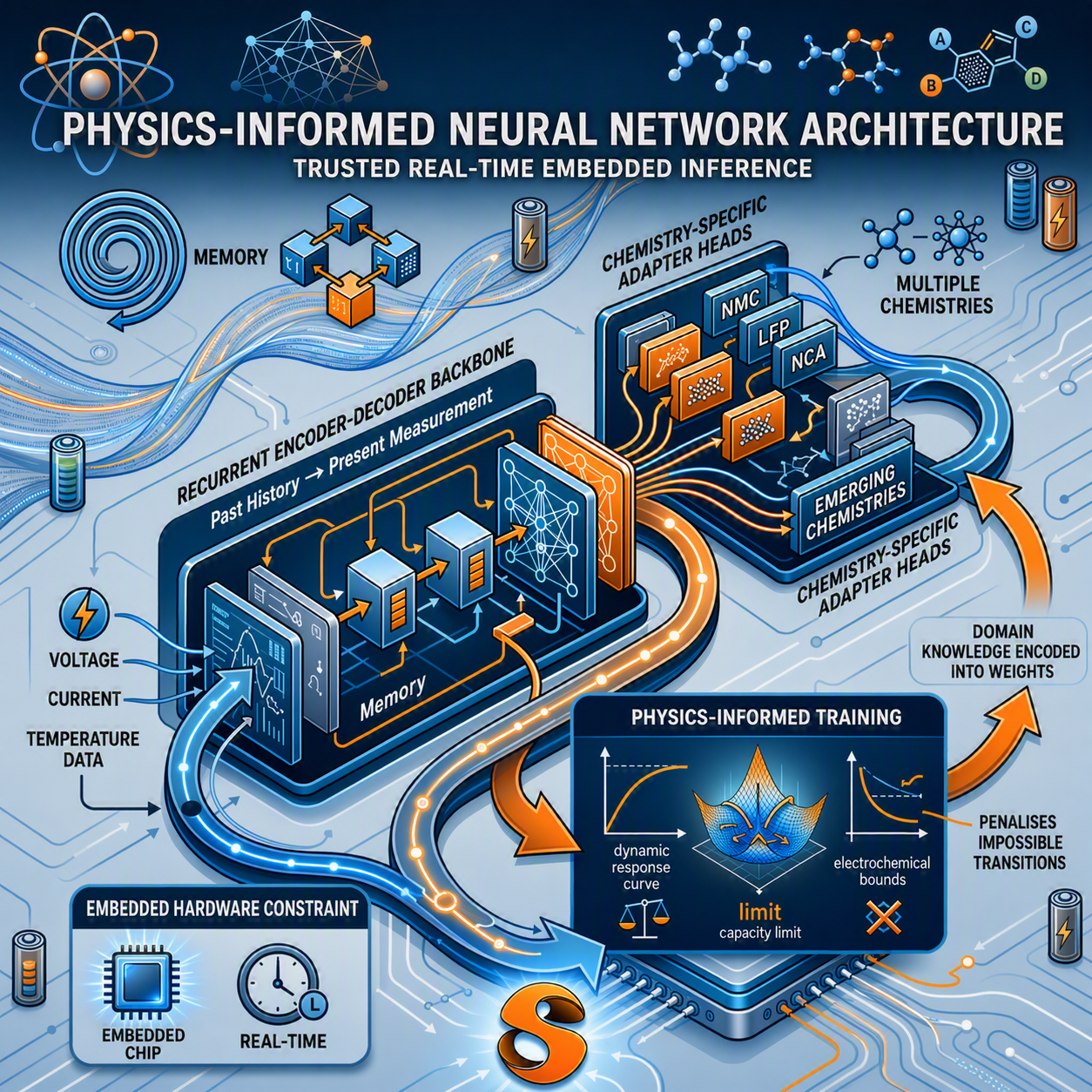
A battery’s true state cannot be measured directly. State of charge, state of health and early signs of degradation or fault must be inferred from voltage, current and temperature, under sensor noise and drift, across changing operating conditions, and as the cell ages. Those estimates have to run in real time on a cost-constrained processor. Getting them wrong affects safety, reliability, performance and lifetime. That combination of a state you cannot measure, a plant that changes over years and a millisecond budget on cheap silicon is why embedded intelligence here has to be physics-informed rather than merely learned.
“A battery cannot be managed from the cloud alone. Critical battery states must be estimated in real time by embedded intelligence running directly on the hardware.”
What makes embedded intelligence trustworthy
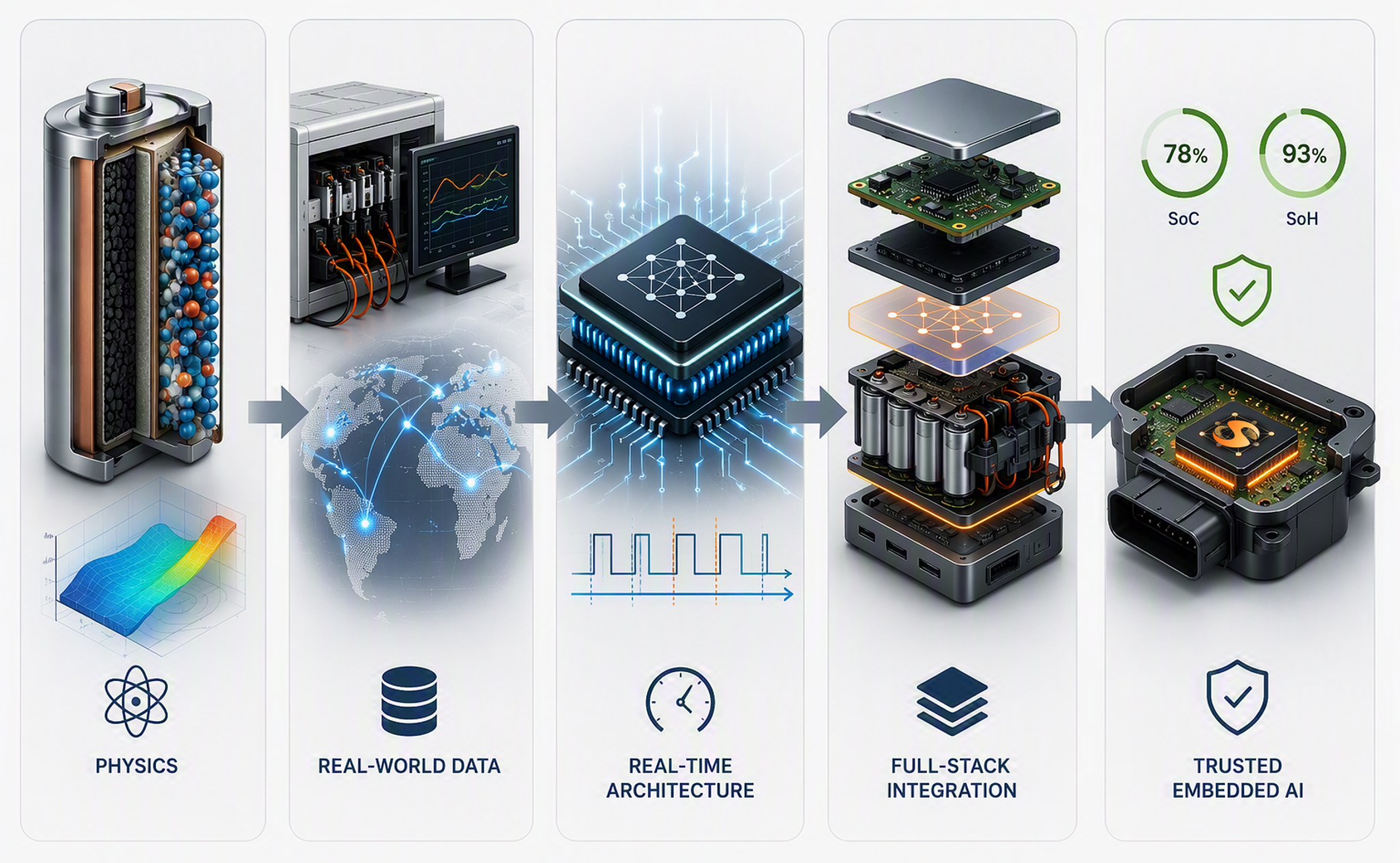
Physics sets the boundaries. Data provides experience built over years in the lab and the field. Architecture enables intelligence to run in milliseconds on constrained hardware. Full-stack integration turns a model into a product that remains reliable for years in operation.
A physics-informed model can infer what sensors cannot directly measure and remain robust beyond the precise conditions represented in its training data.
The same principles apply across motors, power electronics, actuators and flight controllers. But in the electrified world, the battery remains a critical component because performance, availability, safety and lifetime depend on accurate state estimation and control.
Where this leaves us
Physical AI is not AI that observes the world. It is AI that operates within it. It will not be built solely from the top down by increasingly capable coordinating models, nor solely from the bottom up. It will be built where the two layers meet, through trusted, real-time intelligence running directly on the hardware.
High-level models will continue to attract most of the industry’s attention. But whether Physical AI actually works will be decided at the edge, where estimation and control meet physics inside the component itself. In the electrified world, that starts with the battery.
Dr Umut Genc is CEO of Eatron Technologies, a UK-based deep-tech company specialising in AI-powered Battery Optimisation Software for mobility and energy applications. Eatron’s Battery Optimisation Software is production-validated across automotive OEMs, two-wheeler platforms, and grid-scale energy storage systems.