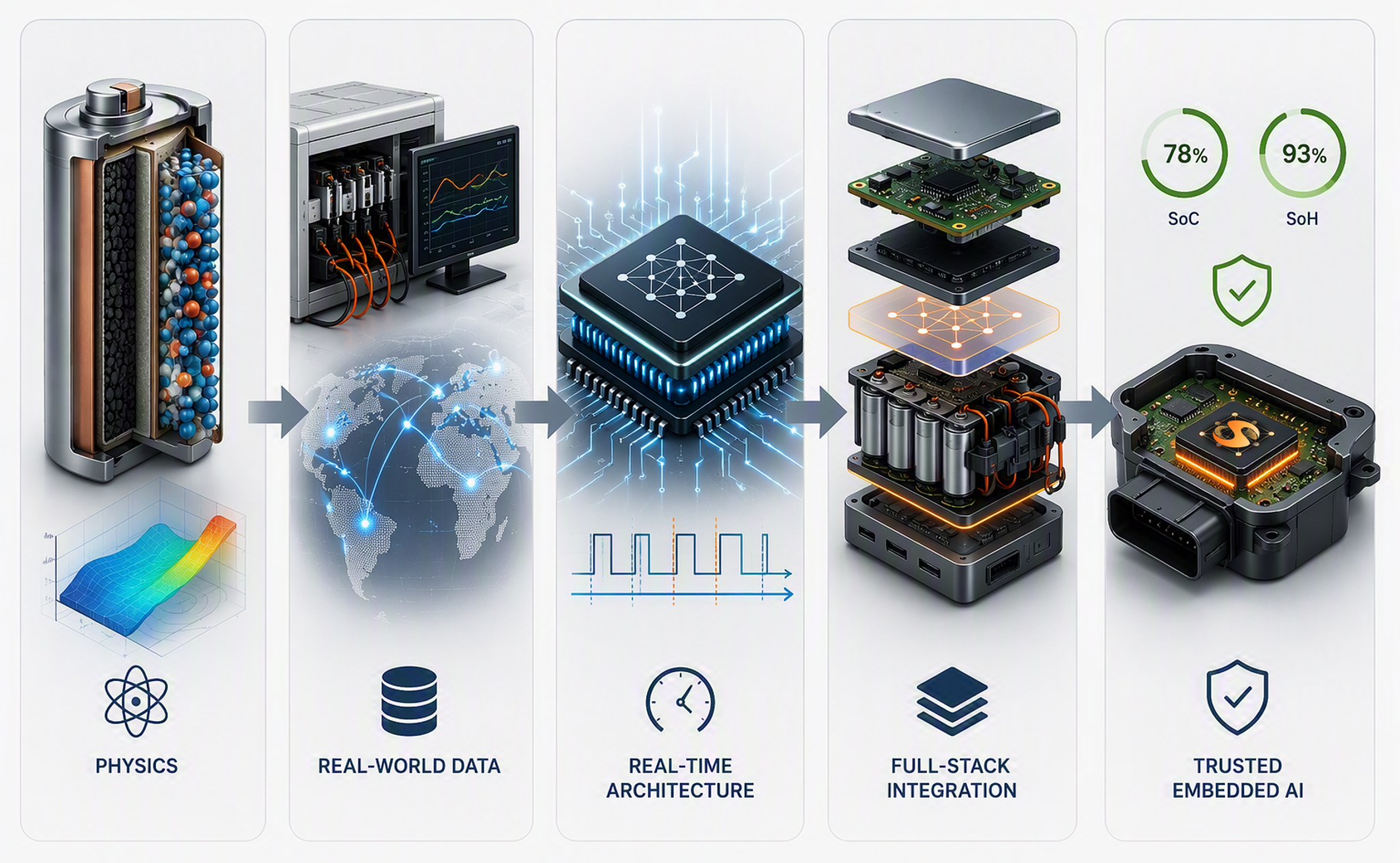
AI is entering the physical world. The rules are changing.

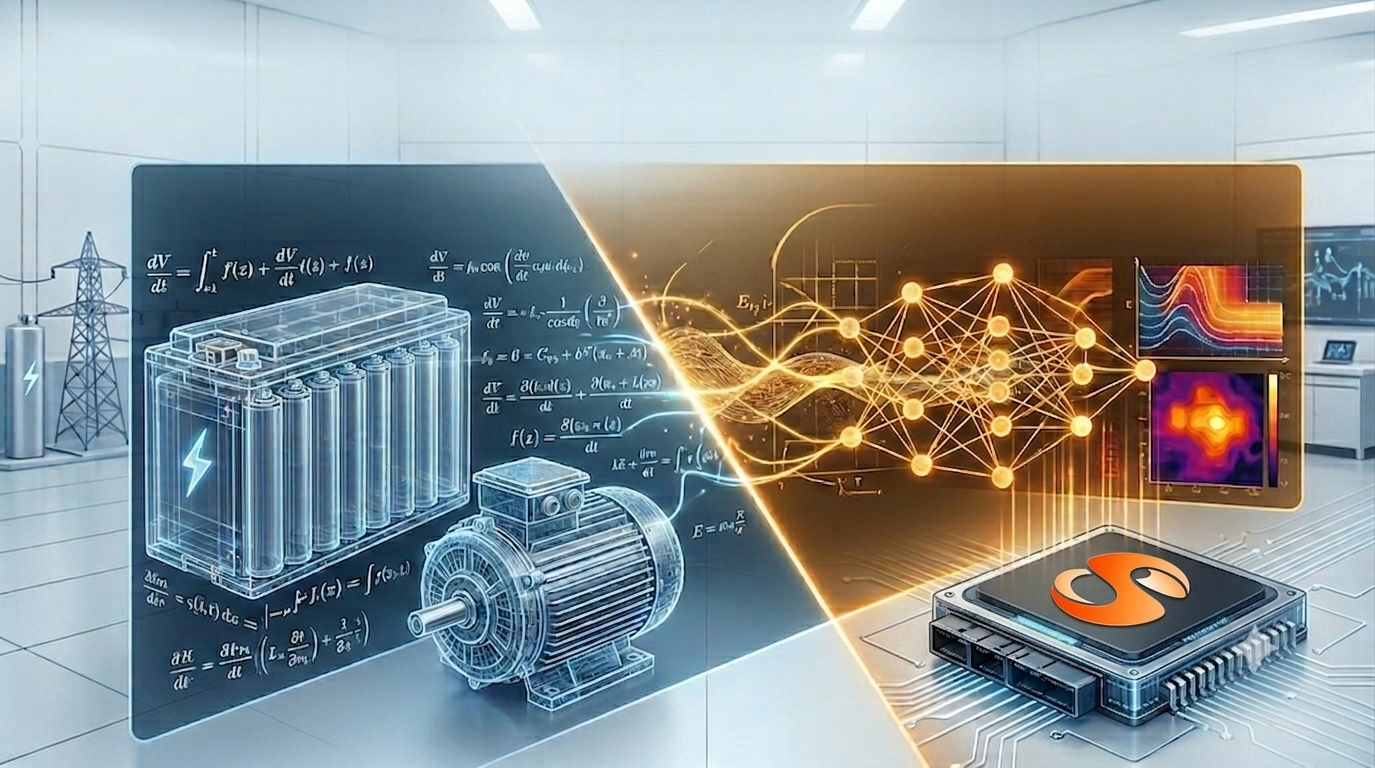
In safety-critical systems, AI is no longer just interpreting information. It is now informing decisions inside batteries, vehicles and energy infrastructure, where performance, lifetime and safety are directly at stake. That is why it must be grounded in physics.
Recently I wrote about the distinction between edge AI and embedded AI, and why that distinction matters for the systems where failure has physical consequences. This week I want to go one level deeper into what that means for the nature of the AI itself.
There is a class of AI problem that receives far less attention than it should. It is the problem of operating physical systems, not just designing them. Not because it is less important, in many ways it is more important, but because it is harder to solve. It requires the AI to do something that language models and image classifiers do not have to do: respect the physics of the system it is modelling.
This is not a small distinction. It separates AI that recognises patterns in data from AI that has to be right about how a physical system will actually behave. And as AI moves deeper into the industrial world, into batteries, motors, power systems, the physical infrastructure the economy depends on, it is this distinction that will determine which AI can be trusted in the physical world, and which cannot.
What most AI was built to do
Most AI systems were built to recognise patterns in data and help design systems. Operating those systems is a fundamentally different problem.
These systems are impressive and genuinely useful. They also share a common property: they do not need to understand the underlying physics of the world they operate in. A language model does not need to know how the brain functions to predict the next word. An image classifier does not need to understand optics to recognise a face.
For a large class of applications such as search, translation, content generation, computer vision, this is entirely sufficient. Pattern matching at scale is powerful.
But for systems that must model and control physical reality, predicting how materials behave under load, how chemical systems evolve over time, or how machines degrade in operation, pattern matching alone will fail. In these cases, respecting the underlying physics is not optional. It is a hard requirement.
Why classical physics models fall short
The obvious response is: we already have physics. We have differential equations, electrochemical models, thermodynamic frameworks. Why do we need AI?
The answer is that classical physics models are very powerful in theory and highly constrained in practice for the complex, nonlinear, multi-variable systems that matter most.
Take a lithium-ion battery cell. Its behaviour depends simultaneously on chemistry, temperature, charge history, age, discharge rate, and dozens of interacting variables. The governing equations that describe this behaviour accurately are well understood in the academic literature. They are also computationally intractable for real time embedded deployment. The simplified models that run fast enough are not accurate across all operating conditions for the decisions that safety-critical systems must make.
This gap cannot be bridged by classical models or unconstrained machine learning. It reflects a fundamental limitation between what physics tells us and what we can compute in real time, on the hardware available in real systems, where decisions have consequences.
“Classical models are too expensive to run in real time. Simplified models are not accurate enough to trust for edge cases. Physics-informed AI lives in the space between them.”
The same limitation exists in electric motor control, structural health monitoring and power conversion systems, in any domain where the underlying physics is rich enough that simplified approximations fail and full-fidelity models are computationally prohibitive. It is a very large class of engineering problems. And it is almost entirely underserved by the current generation of AI.
What physics-informed AI actually is
Physics-informed AI, as we have built it at Eatron, is not black-box machine learning applied to physical data. Nor is it a classical physics solver approximated by a neural network.
It is explicitly designed for this problem.
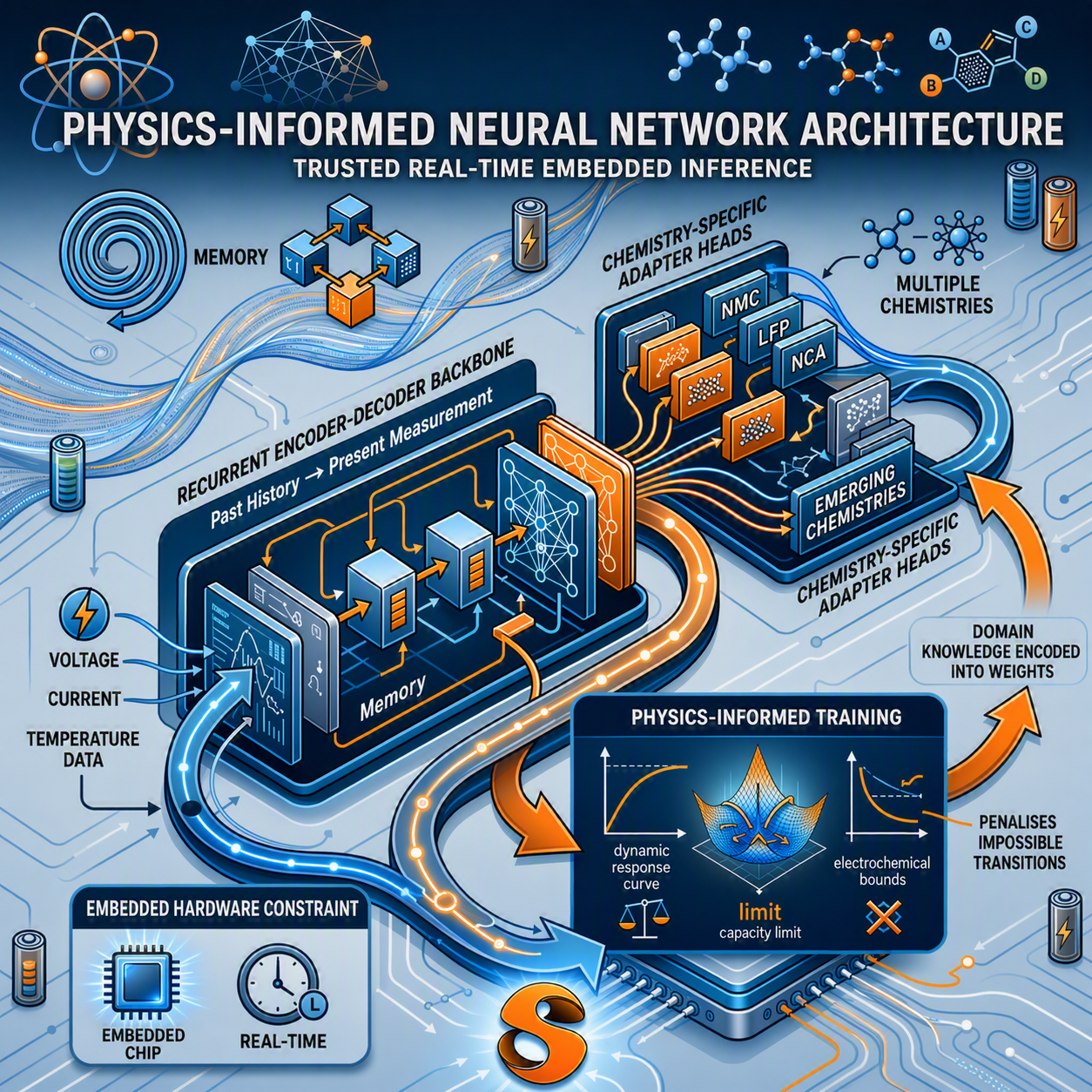
The architecture starts with a recurrent neural network designed to capture system dynamics, where the current state determined by past behaviour. Batteries do not have a state that can be determined from a single measurement. Their behaviour at any moment reflects everything that has happened to them before: every charge cycle, every temperature excursion, every discharge event. A model that ignores this history cannot be accurate. A recurrent architecture captures it
The training process then introduces physics as a constraint on what the model is permitted to learn. Physically meaningful capacity fade curves, electrochemical limits, thermodynamic relationships are explicitly baked into the training objective. The model cannot converge on solutions that violate physics, even when the data would otherwise allow it. This is the critical distinction from black-box machine learning: the model is not free to fit any pattern in the data. It is constrained to learn patterns that remain physically valid.
“The model cannot learn solutions that violate physics. Domain knowledge is in the weights not layered on as post-processing.”
We chose batteries as the proving ground because they are among the hardest physical systems to model accurately in real time: deeply nonlinear, chemistry-dependent, safety-critical, all operating on constrained embedded silicon. If physics-informed AI works here, it has a strong basis to transfer to other physical systems where the same constraints apply.
The models we built are deployed today in automotive and energy applications. Not in research environments. In production systems, validated against the standards that safety-critical deployment demands.
This is not a theoretical problem. It is already a limitation in real deployments.
Why this matters now
This reflects a broader shift in how AI is being applied in industry.
The AI industry proved in its first decade that pattern matching at scale works. The next frontier is AI applied to physical reality in scientific discovery, in materials research, in industrial systems. Most of the attention so far has gone to using AI in the design and simulation of physical systems: large models that replace expensive computation, accelerate engineering, and build digital twins. That is real and valuable work.
But there is a second frontier, and it is the harder one. It is not AI that helps engineers design a system, but AI that operates inside the system once it is deployed. This means running in real time, on constrained embedded hardware, making decisions while the system is live. Designing a battery with AI and operating one with AI are fundamentally different problems. Only the latter requires the AI to respect physics continuously, under real-world conditions, where errors have direct consequences.
That is the frontier we have spent years building for. Physics-informed AI is how we make this intelligence trustworthy, by constraining it with the physical laws of the system. Embedded deployment is where that intelligence must operate. The two together are what physical systems actually require.
Any physical asset that requires real time monitoring, prediction and control such as batteries, motors, power systems, falls into this category. These are systems where classical models are too slow and unconstrained machine learning cannot be trusted. In these cases, the AI must accurately reflect the underlying physical behaviour of the system it governs.
Systems that operate in the physical world do not tolerate approximation. They require models that respect underlying physics, in real time, on constrained hardware. That is not a soft constraint. It defines the next generation of intelligent systems.
Dr Umut Genc is co-founder and CEO of Eatron Technologies, a UK-based deep-tech company specialising in AI-powered Battery Optimisation Software for mobility and energy applications. Eatron’s Battery Optimisation Software is production-validated across automotive OEMs, two-wheeler platforms, and grid-scale energy storage systems.