A Neural Network That Cannot Break the Laws of Physics

How we built the architecture behind Eatron’s battery AI, and why the design is the reason it can be trusted in real time
Most machine learning is free to find whatever pattern fits the data. For a model that runs inside a battery, that freedom is the problem, not the feature.
Over the past few weeks we have written about what it means to deploy AI inside physical systems, why that AI has to respect physics, and why the data behind it is so hard to build. I want to go one level deeper and talk about the architecture itself. How the model is actually built, and why those design choices are what let it run in real time, on embedded hardware, in a system where being wrong has consequences.
This is a more technical article than the previous ones. That is deliberate. The architecture is where the claims in the earlier articles either hold up or fall apart.
The two easy answers, and why we rejected both
When you set out to model a battery, there are two well-trodden paths. Both are wrong for this problem, in opposite ways.
The first is the classical physics approach: write down the governing equations of the electrochemistry and solve them. These models are rigorous and interpretable. They are also far too heavy to run in real time on the kind of processor that actually sits inside a battery system, and the simplified versions that are light enough lose accuracy exactly where you need it most, at the edges of the operating envelope.
The second is the pure machine learning approach: take a flexible neural network, feed it enough data, and let it learn the input-output mapping. This is fast at inference and often accurate on average. But it is a black box, and worse, it is free to learn relationships that are physically impossible. A model that has only ever seen normal operation can confidently produce a nonsensical answer when it meets a situation outside its training data. In a safety-critical system, confidently wrong is the most dangerous failure mode there is.
“A black-box model is free to learn relationships that are physically impossible. In a safety-critical system, confidently wrong is the most dangerous failure there is.”
We wanted the accuracy and speed of the learned approach, without the freedom to violate physics. That requirement shaped every decision that followed.
Recurrent by design, because batteries have memory
The first decision is the type of the network. A battery does not have a state you can read from a single instantaneous measurement. Its behaviour right now depends on its entire history: every charge cycle, the temperature distribution, every deep discharge, the rate at which it was used, how it was stored. The same voltage and current can mean very different things in two cells with different histories.
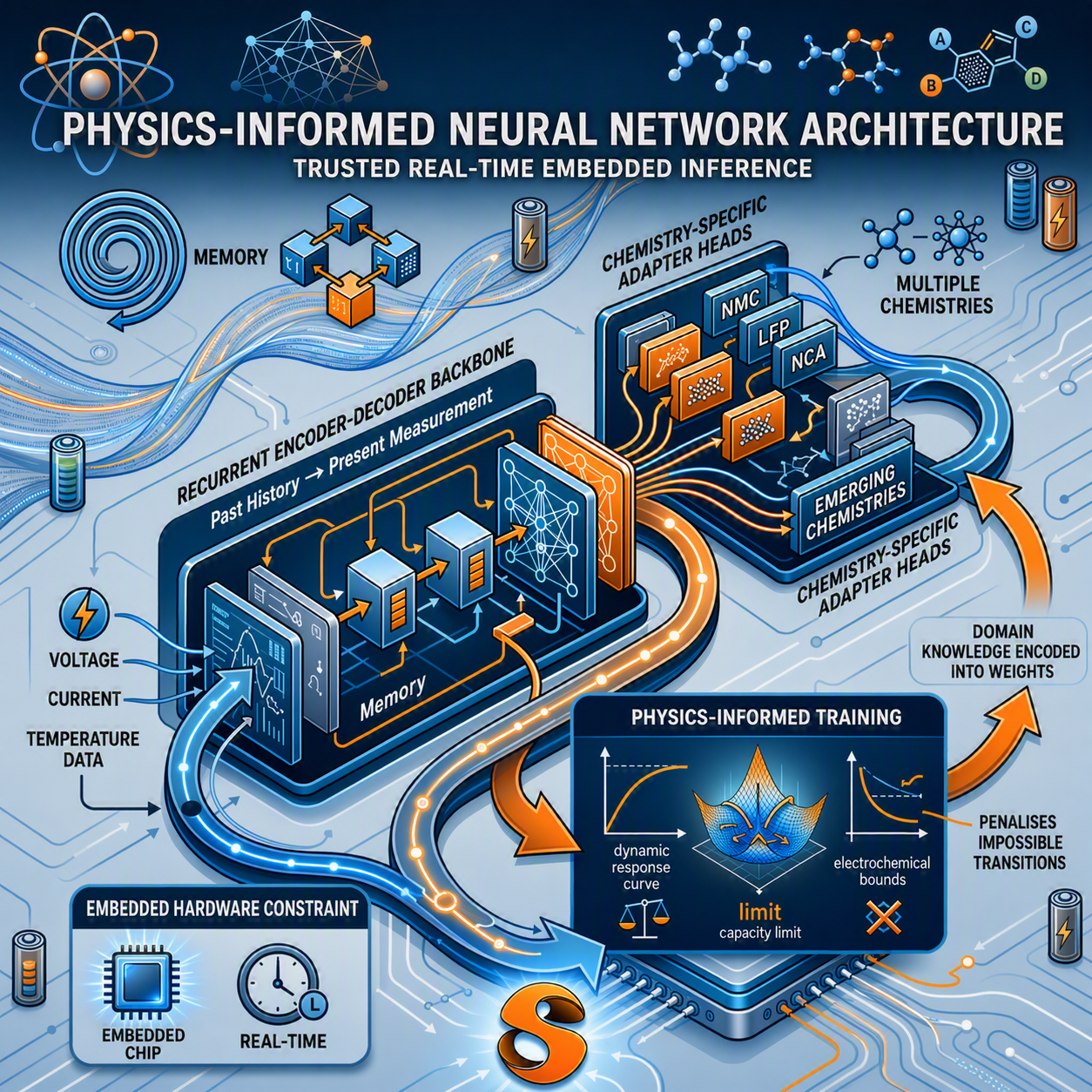
That makes this a sequence problem, not a snapshot problem. Our backbone is a recurrent encoder-decoder, built to carry state forward through time and to interpret the present measurement in the context of everything that came before. A feed-forward network that looks only at the current input throws that history away, and with it the information that matters most for predicting how a cell will behave next.
Physics in the loss function, not bolted on afterward
The recurrent backbone gives the model the right architecture. The next decision is what stops it from learning physically impossible behaviour. This is where physics-informed training comes in, and it is the heart of the design.
Rather than train the network only to match measured outputs, we shape the loss function with physics. Physically meaningful constraints, things like realistic capacity and impedance change behaviour, physically meaningful dynamic response under load and electrochemical limits, are built directly into what the model is rewarded and penalised for during training. The model is not just asked to fit the data. It is required to fit the data in a way that stays physically consistent.
The effect is that domain knowledge ends up baked into the model weights, rather than being applied as a correction layer afterward. The network learns representations of battery behaviour that respect the physics by construction. When it meets a situation it has not seen before, it does not fall off a cliff into a physically impossible answer, because the space of answers it can produce has been constrained during training.
“We shape the loss function with physics. The model is not just asked to fit the data. It is required to fit it in a way that stays physically consistent.”
This is the practical meaning of physics-informed AI. Not a marketing label, but a specific choice about where physical knowledge lives in the system. In the weights, learned, not in a post-processing step that tries to catch mistakes after the model has made them.
One architecture, many chemistries
A model that only works on one cell chemistry is a research result, not a product. NMC, LFP, NCA and emerging chemistries behave differently enough that a naive approach would need a separate model trained from scratch for each, which does not scale.
We handle this with a shared backbone and chemistry-specific adapter heads. The encoder-decoder learns the behaviour common to lithium-ion systems in general, the deep structure that all these chemistries share. Smaller adapter heads then specialise that shared understanding to a particular chemistry. Moving to a new chemistry means training a relatively small adapter on top of the existing backbone, rather than rebuilding the whole model. The shared foundation is what makes the platform extensible instead of a collection of one-off models.
Built for the edge from the first line of code
All of this has to run in real time, on the constrained processor inside the battery system, producing cell-level estimates continuously while the system operates. This is not a model we trained in the cloud and then tried to shrink to fit. The constraint of embedded, real-time execution was a design input from the start, and it influenced the size, structure and implementation of the network at every step.
That is the difference I would most want an engineer reading this to take away. The architecture was not optimised for a benchmark and then heavily pruned and quantized to be able to run on hardware. It was shaped, from the beginning, by the requirement to run inside the product, in real time, without breaking physics. Every choice, the recurrent backbone, the physics-informed loss, the adapter heads, serves that single requirement.
“This is not a cloud model we shrank to fit. Embedded, real-time execution was a design input from the get go”
Architecture is where the promises made in the earlier articles get tested. Physics-informed AI is only meaningful if the physics is genuinely in the model. Real-time embedded operation is only real if the network was built to run on the hardware. The design choices are the proof. In the next article we move from how the model is built to where all of this is heading: the full path from silicon to software, and why the stack cannot be assembled quickly from parts.
Can Kurtulus is CTO of Eatron Technologies, a UK-based deep-tech company specialising in AI-powered Battery Optimisation Software for mobility and energy applications. Eatron’s Battery Optimisation Software is production-validated across automotive OEMs, two-wheeler platforms, and grid-scale energy storage systems.